At my house, we are planning to take our traditional hike after Thanksgiving dinner, if it is not raining. Another tradition is that the girls do the cooking and the guys do the dishes. We'll see if Jeremiah helps me and Tyler this year.
Often we go see a movie on Thanksgiving. I don't know if we will do that this year. The prices of movie tickets keeps going higher and higher. One way we've found to beat that is to go to the cheap theater. I recommend this. We go mostly to Crossroads at Grant and Swan (since it is a local theater) and occasionally to Century Gateway 12 on Kolb between Broadway and Speedway.
HERE IS GOOD THANKSGIVING READ FROM THE PEOPLE AT RELEVANT MAGAZINE:
Thanksgiving is upon us once again. The time of year when we get together with family and friends, eat ourselves into a mild coma and fall asleep on the couch watching plasticine announcers make asinine comments about enormous cartoon-character balloons, or look on in horror as John Madden greedily devours this year’s turducken. Without a doubt, it is the pinnacle of the American experience. Certainly, though, the time-honored holiday has to signify more than an excuse to gorge ourselves on pies and various starches. After the hectic madness of each year, and before the brutal onslaught of the Christmas rush, Thanksgiving at least offers us the opportunity to sit back and consider the things in our lives for which we have to be grateful.
But thankfulness isn’t easy for a lot of us these days. With the economy spiraling out of control, many people are more worried about their jobs and houses than finding the perfect place-setting for their family gathering. Some of us have had a downright horrible year. Thankfulness can be a very difficult attitude when we’ve faced a lot of life’s trials. Health issues, relationship troubles, family dramas—all of these things can make it hard to put ourselves in a very thankful mood, and Thanksgiving day becomes nothing more than another salute to gastronomical excess. The very moniker of the holiday is ignored.
Sometimes, in the midst of a complicated world, we can be tempted to cast a wistful eye to the origins of the holiday. Modern society seems so much more complicated than the idyllic days of the first Thanksgiving. The celebrants of the first Thanksgiving had none of the woes forced upon us by industrialization and the information age. Their woes were, of course, far worse. Though there is dispute about where the first Thanksgiving was celebrated (most scholars say it was St. Augustine, Fla., in 1565 rather than Plymouth, Mass., in 1621) one thing is certain: Disease, hunger and a grueling physical environment were all realities in the days of the first Thanksgiving celebrations. They gave thanks in the midst of circumstances it is hard for us to imagine in modern day America. Fully half of the settlers in Plymouth died the first winter. Governor William Bradford’s young wife died before the ship even landed, by falling overboard. We give thanks because we got our turkey on special at Safeway, and Uncle Carl miraculously didn’t embarrass us this year. They gave thanks for not dying in the previous calendar year. Pretty heavy stuff.
It puts a lot of things in perspective to think of those few, first brave pioneers from Europe. While their motives and methods of colonizing North America are often questionable in the light of history, their courage and fortitude are not. Certainly, they knew hardships few of us could comprehend. Yet, in the midst of it all, they set aside time to honor and thank God for His provision.
It is hard to give thanks to God when we don’t see His goodness. Sometimes the providence of the Almighty seems much more an abstract concept than a reality. Yet, thankfulness should be a part of the very fabric of our beings, in spite of circumstance. The apostle Paul was an absolute model of this attitude. Few people had the laundry list of grievances that Paul did: shipwrecked, stoned, beaten, imprisoned. Yet his attitude throughout his writings is one of constant thanksgiving, even while in chains. He tells the church at Thessalonica:
“Rejoice always, pray continually, give thanks in all circumstances; for this is God’s will for you in Christ Jesus” (1 Thessalonians 5:16-18).
Thankfulness in all circumstances is not intended to massage God’s ego. Rather, thankfulness is an attitude that ultimately benefits us. When we give thanks to God in the midst of hardships, we are reminded of certain incontrovertible truths: God is good, God is gracious and God has our best interests at heart. By keeping these truths in mind, our faith becomes stronger. We begin to have the resolve to trust God, and the outgrowth of that is a new sense of peace when trouble arrives. Moreover, it’s a tremendous example to the rest of the world. To give thanks and praise to God when things are going tremendously well in our lives doesn’t prove a lot to people outside the community of faith. But to show that same thankfulness when our world is falling apart, that’s an attitude that speaks multiplied volumes.
Thanksgiving should not be limited to one day a year, but let’s start there. Let’s resolve to spend this holiday in a true condition of thankfulness. Perhaps this year hasn’t lived up to your expectations. Perhaps it’s been your worst year. Maybe Thanksgiving is actually going to be a tremendously lonely time for you. In spite of all this, give thanks. Thank God for the fact that He gave you life, and that He intends to give it to you more abundantly. That may not always resemble what we have in mind, but it will always be what’s best.
Author: Fred Burrows
Wednesday, November 26, 2008


Thursday, November 20, 2008
Sunday November 23, 2008
In the church year, this Sunday is Christ the King Sunday. One idea that struck me from the article in the link is from Cyril of Alexandria, who stated that Christ's Kingship is not obtained by violence: "Christ has dominion over all creatures, a dominion not seized by violence nor usurped, but his by essence and by nature."
Christ the King Sunday always comes the last of the church year, the last Sunday before the beginning of Advent.
This Sunday is also the Sunday before Thanksgiving. We will attempt to incorporate both themes into our worship for this Sunday.
The worship bulletin is here.
Christ the King Sunday always comes the last of the church year, the last Sunday before the beginning of Advent.
This Sunday is also the Sunday before Thanksgiving. We will attempt to incorporate both themes into our worship for this Sunday.
The worship bulletin is here.
Computer transition is tough
My old Toshiba laptop that I bought in 2004 really started messing up a couple of weeks ago. The CPU ran at 100% all the time. It was hard to even run one program at a time, let alone more than one. Our network/computer guy worked on it and then I did, too, for a few days. It improved some, but not a lot. So, I bit the bullet and bought a new computer. It's another Toshiba laptop. I got it at Best Buy. It fit the criteria I was looking for: it is powerful and fast and was on clearance. (I'm cheap, OK). I told that story to explain my blogging absence of late. Not only did I have computer problems, but then I lost lots of time in setting up the new computer. Isn't that how it is? A new computer solves some problems, but then creates a whole set of new challenges. Fortunately, I'm almost done. All I've got to do is figure how to connect to the church MS Exchange server so I can get my email. All last week I ran both computers on my desk: one for my church email, one for everything else. I wonder if I looked really important?
Thursday, November 13, 2008
Download the Cornerstone CD!
http://www.digstation.com/ArtistAlbums.aspx?albumid=ALB000024378
Click this link to purchase and download songs from the Cornerstone CD (or the whole thing!).
Click this link to purchase and download songs from the Cornerstone CD (or the whole thing!).
Micah 6.8, part 3
For the past few weeks, we have been considering Micah 6.1-8 in The Refuge. This is an interesting and important passage of Scripture that asks and answers the question:"What does God want from us?". The first two parts of the answer are do justice and love kindness (chesed). The third part is "walk humbly with your God". What does this mean? I think we can state it simply like this: realize that God is God and you are not. To walk humbly with God means to recognize our place and God's place. We are not in control. We are not in control of the world. We are not in control of our lives. And we are certainly not in control of God.
It is easy for us to believe (unconsciously, almost--we would never admit to this) that the world revolves around us. But just as Galileo and Copernicus brought us to understand that the earth is not the center of the universe (or even our galaxy), so we need to come to the paradigm-shifting, earth-shaking understanding that we are not the center of the world. So often we behave and think like God is part of our world. The truth is that this is God's world, and we are only small parts in it.
Another way we need to walk humbly with God is to understand and admit the limitations of our understanding of God. It is our nature to think that we are right, that we understand properly, and that anyone who disagrees with us is wrong. But we need to disagree with us. We need to see that our concepts of God are just that: our concepts of God. God is bigger, and more complex, and more mysterious, and just MORE than we can ever conceive. In his book How (Not) to Speak of God, Peter Rollins describes a position he calls a/theism. This means that we are both theists (believers in God) and atheists (disbelievers in God). We believe in God, but we (at the same time) do not believe our own concepts of God. Another way to say that is we do not limit God to our understanding of God. We will try to explore this a little more Sunday morning.
Here is the worship bulletin.
It is easy for us to believe (unconsciously, almost--we would never admit to this) that the world revolves around us. But just as Galileo and Copernicus brought us to understand that the earth is not the center of the universe (or even our galaxy), so we need to come to the paradigm-shifting, earth-shaking understanding that we are not the center of the world. So often we behave and think like God is part of our world. The truth is that this is God's world, and we are only small parts in it.
Another way we need to walk humbly with God is to understand and admit the limitations of our understanding of God. It is our nature to think that we are right, that we understand properly, and that anyone who disagrees with us is wrong. But we need to disagree with us. We need to see that our concepts of God are just that: our concepts of God. God is bigger, and more complex, and more mysterious, and just MORE than we can ever conceive. In his book How (Not) to Speak of God, Peter Rollins describes a position he calls a/theism. This means that we are both theists (believers in God) and atheists (disbelievers in God). We believe in God, but we (at the same time) do not believe our own concepts of God. Another way to say that is we do not limit God to our understanding of God. We will try to explore this a little more Sunday morning.
Here is the worship bulletin.
Thursday, October 30, 2008
Sunday November 2
This will be our annual All Saints/All Souls Observance. There is a difference between the two. All Saints Day is November 1 and commemorates (officially--in the Catholic church) all persons who have attained the status of saint. Some more prominent saints have their own feast days throughout the year, but All Saints Day especially honors those who do not. All Souls Day is on November 2 and is for the rest of us--departed ones who have not been officially designated saints by the Catholic Church. In this respect, it is sort of like Festivus (for the rest of us). So technically, all of the observances we do at Catalina (and probably all Protestant churches) is really All Souls, not All Saints (no matter what we call it or what day we celebrate it); since we do not venerate official Catholic saints on that day, we remember loved ones who have departed. However, since we Protestants believe that all believers are saints (see Romans 1.7, 8.27, 12.13, 15.25-31), I suppose we could call our observances All Saints Day.
This week's worship bulletin is here. There is an introduction to All Saints/All Souls Day there.
For this Sunday:
ALL SAINTS WORSHIP EXPERIENCE
We will offer several prayer stations during our worship service today. Instructions will be given. This type of experience may be new to you, but rest as-sured, there is no right way or wrong way to participate! Simply be open to God in all the experiences. There is no set order to go in, or any pressing need to visit all of the stations. Take your time. Pay attention to your soul. Remem-ber those who are gone. We will come together right before communion for a Remembrance of the Blessed Ones. This will be an opportunity for you to come to the front and speak the name of someone you want to remember. We will use the format “Blessed is (name of the person), who (say a few things about his/her life).” Then you will have the opportunity to light a candle in memory of that person on your way to seat.
This Sunday will also be communion Sunday.
A BLESSING FOR ALL SAINTS DAY
Maybe in this there has been a glimpse of the kingdom
A foretaste, a hint, a promise
Let it hold you and let it send you
So you will never be at peace
Until all are fed, until all know home, until all are free, until justice is done,
Until peace is the way, until grace is the law, until love is the rule,
Until God’s kingdom comes. Amen.
PICK UP YOUR GREEN CARD! There are some small green cards on the back round table that you can use to participate in the Ignatian Examen during All Saints season. Simply pause at the end of your day and reflect. For what moment was I least grateful? Record your answer and pray about that. For what moment was I most grateful? Record your answer and thank God. The card with instructions is online at http://catumc.org/files/ignatianexamenallone.pdf
Our All Saints prayers and liturgies are online here if you are interested.
May the grace and peace of the Lord Jesus Christ be with you now and forevermore. Amen.
This week's worship bulletin is here. There is an introduction to All Saints/All Souls Day there.
For this Sunday:
ALL SAINTS WORSHIP EXPERIENCE
We will offer several prayer stations during our worship service today. Instructions will be given. This type of experience may be new to you, but rest as-sured, there is no right way or wrong way to participate! Simply be open to God in all the experiences. There is no set order to go in, or any pressing need to visit all of the stations. Take your time. Pay attention to your soul. Remem-ber those who are gone. We will come together right before communion for a Remembrance of the Blessed Ones. This will be an opportunity for you to come to the front and speak the name of someone you want to remember. We will use the format “Blessed is (name of the person), who (say a few things about his/her life).” Then you will have the opportunity to light a candle in memory of that person on your way to seat.
This Sunday will also be communion Sunday.
A BLESSING FOR ALL SAINTS DAY
Maybe in this there has been a glimpse of the kingdom
A foretaste, a hint, a promise
Let it hold you and let it send you
So you will never be at peace
Until all are fed, until all know home, until all are free, until justice is done,
Until peace is the way, until grace is the law, until love is the rule,
Until God’s kingdom comes. Amen.
PICK UP YOUR GREEN CARD! There are some small green cards on the back round table that you can use to participate in the Ignatian Examen during All Saints season. Simply pause at the end of your day and reflect. For what moment was I least grateful? Record your answer and pray about that. For what moment was I most grateful? Record your answer and thank God. The card with instructions is online at http://catumc.org/files/ignatianexamenallone.pdf
Our All Saints prayers and liturgies are online here if you are interested.
May the grace and peace of the Lord Jesus Christ be with you now and forevermore. Amen.
Tuesday, October 28, 2008
I'm with Jim Wallis
Over on Bart Campolo's blog, I found this article by Jim Wallis about his faith priorities which will guide his voting in the election. Good stuff. Read it even if (especially if?) you don't agree.
Ignatian Examen
We started a new spiritual practice this week in the Catalina youth group and in the Refuge: the Ignatian Examen. Download and print the page here and it will give you a form to use and instructions and introduction. The examen is a great way to reflect on your life. I think it is especially appropriate during this All Saints season.
U of A Band Day
Here is the schedule for U of A Band Day, this Saturday, November 1.
http://web.cfa.arizona.edu/uabands/pdf/BDSchedule08.pdf
Just so you don't have to read the whole thing, Sahuaro performs around 4:40pm.
http://web.cfa.arizona.edu/uabands/pdf/BDSchedule08.pdf
Just so you don't have to read the whole thing, Sahuaro performs around 4:40pm.
Thursday, October 23, 2008
Sunday October 26
I know, I know. I should blog about more than just what is happening on Sunday. And I do have some things I want to share. I will try to get to these. But for now, here is what is happening Sunday.
The worship bulletin is here.
This week we are starting a new study on Micah 6.1-8. This passage of Scripture asks and answers an important question: What does God require of us? There are a lot of ways to answer this question and there are a lot of answers being touted as THE answer to that question. But take a look at this Scripture passage. Does the answer in verse 8 surprise you? Do the suggested not-valid answers in verses 6-7 surprise you?
The worship bulletin is here.
This week we are starting a new study on Micah 6.1-8. This passage of Scripture asks and answers an important question: What does God require of us? There are a lot of ways to answer this question and there are a lot of answers being touted as THE answer to that question. But take a look at this Scripture passage. Does the answer in verse 8 surprise you? Do the suggested not-valid answers in verses 6-7 surprise you?
Thursday, October 16, 2008
Sunday October 19
This Sunday I will be camping at Picacho Peak State Park with the Catalina youth group. Pastor Ed will be preaching. We will also have great music, including a solo by Amy Tober (freshman at Empire High School) and Kendra McLean will be our percussionist. (Tyler is also going camping!) The worship bulletin is here.
Thursday, October 09, 2008
Sunday October 12
This will be our last study in our series on the Psalms. I have really liked doing this. Looking at the Psalms gives you a ready-made portion of Scripture to study--you already have your boundaries set for you. And the Psalms were written to be used in worship (most) in ancient Israel, so they are naturals to include in our worship. And the Psalms cover real-life stuff and the gamut of human emotions. So it is with great sadness that I will leave the Psalms after this Sunday.
But we won't be leaving the Old Testament! We are going to spend 3-4 weeks looking at a very important Scripture: Micah 6.8.
Anyway, we finish this week with Psalm 139; a great song of God's love, care, and power.
The worship bulletin for this Sunday is here.
Here is a excerpt from this Sunday's study:
Psalm 139 is a seduction. It is a love story. God knows you the way a lover knows the beloved. God will never leave you. God knows all your secrets and still he is the truest lover of all.
This poem, "Let Your God Love You", by Edwina Gately will be used as a closing meditation this Sunday.
Be silent.
Be still.
Alone.
Empty.
Before your God.
Say nothing.
Ask nothing.
Be silent.
Be still.
Let your God
Look upon you.
That is all.
God knows.
God understands.
God loves you
with an enormous love,
And only wants
to look upon you
with that love.
Quiet.
Still.
Be.
Let your God--
Love you.
But we won't be leaving the Old Testament! We are going to spend 3-4 weeks looking at a very important Scripture: Micah 6.8.
Anyway, we finish this week with Psalm 139; a great song of God's love, care, and power.
The worship bulletin for this Sunday is here.
Here is a excerpt from this Sunday's study:
Psalm 139 is a seduction. It is a love story. God knows you the way a lover knows the beloved. God will never leave you. God knows all your secrets and still he is the truest lover of all.
This poem, "Let Your God Love You", by Edwina Gately will be used as a closing meditation this Sunday.
Be silent.
Be still.
Alone.
Empty.
Before your God.
Say nothing.
Ask nothing.
Be silent.
Be still.
Let your God
Look upon you.
That is all.
God knows.
God understands.
God loves you
with an enormous love,
And only wants
to look upon you
with that love.
Quiet.
Still.
Be.
Let your God--
Love you.
Thursday, October 02, 2008
World Communion Sunday October 5
Can you believe it is OCTOBER?? I can't. Where did September go?
The first Sunday in October is World Communion Sunday. You can read a little history of the event here. Of course, the biggest point of World Communion Sunday is the WORLD part: the unity of all believers all around the world sharing in the same observance--the same body of Christ. But I also like to emphasize the COMMUNION part. I believe that Holy Communion is not understood and is generally under-appreciated. That is why I take World Communion Sunday to talk about the importance and meaning of communion. Just as Christians have different views on baptism, so there are many different views on communion. Our Roman Catholic brothers and sisters celebrate the Mass, and believe that the bread and wine become the actual body and blood of Christ. Our non-sacramental, evangelical brothers and sisters believe it is an ordinance--simply something we are commanded to do--so we do it. Some also believe it is a memorial to Jesus. But most evangelicals believe that communion is completely symbolic. If it has an spiritual significance, it is all due to your attitude, your receptivity to God.
The United Methodist understanding of communion is officially stated in This Holy Mystery, a document adopted at the 2004 General Conference. Although there is a lot to say about communion, I will stop with saying that in the UMC, communion is a sacrament (see Article 16 here). That is to say that communion is a means of grace. God does something during communion, not just us. It is not just us taking the bread and the cup--that is a minor part--but God is with us and is working his grace in us in communion. That is what it means to have a sacramental view of communion. In other words, if one person comes to communion not interested and zoned out like a zombie, and another person comes to communion spiritually alert and with a heart of prayer, God's grace comes to both of them. Obviously the latter person will feel a more meaningful experience than the church zombie.
I think communion is VERY IMPORTANT. You will hear 6 things that I think communion means to us as Christians on Sunday. The worship bulletin is here.
And remember, Jesus instituted communion or the Lord's Supper during the observance of the Jewish Passover meal. How does the significance of the Passover to the Jewish disciples inform what Jesus was presenting with communion?
Interesting stuff to think about !
The first Sunday in October is World Communion Sunday. You can read a little history of the event here. Of course, the biggest point of World Communion Sunday is the WORLD part: the unity of all believers all around the world sharing in the same observance--the same body of Christ. But I also like to emphasize the COMMUNION part. I believe that Holy Communion is not understood and is generally under-appreciated. That is why I take World Communion Sunday to talk about the importance and meaning of communion. Just as Christians have different views on baptism, so there are many different views on communion. Our Roman Catholic brothers and sisters celebrate the Mass, and believe that the bread and wine become the actual body and blood of Christ. Our non-sacramental, evangelical brothers and sisters believe it is an ordinance--simply something we are commanded to do--so we do it. Some also believe it is a memorial to Jesus. But most evangelicals believe that communion is completely symbolic. If it has an spiritual significance, it is all due to your attitude, your receptivity to God.
The United Methodist understanding of communion is officially stated in This Holy Mystery, a document adopted at the 2004 General Conference. Although there is a lot to say about communion, I will stop with saying that in the UMC, communion is a sacrament (see Article 16 here). That is to say that communion is a means of grace. God does something during communion, not just us. It is not just us taking the bread and the cup--that is a minor part--but God is with us and is working his grace in us in communion. That is what it means to have a sacramental view of communion. In other words, if one person comes to communion not interested and zoned out like a zombie, and another person comes to communion spiritually alert and with a heart of prayer, God's grace comes to both of them. Obviously the latter person will feel a more meaningful experience than the church zombie.
I think communion is VERY IMPORTANT. You will hear 6 things that I think communion means to us as Christians on Sunday. The worship bulletin is here.
And remember, Jesus instituted communion or the Lord's Supper during the observance of the Jewish Passover meal. How does the significance of the Passover to the Jewish disciples inform what Jesus was presenting with communion?
Interesting stuff to think about !
Wednesday, September 24, 2008
Check out the photos...
of my cruise last week! We had a great time!
Mobile post sent by richardleejones using Utterli.
Check out the photos...
of my cruise last week! We had a great time!
Mobile post sent by richardleejones using Utterli.
Tuesday, September 23, 2008
Back from the Cruise!!
Hey, it's great to be home after our cruise! Of course it is hard to get back to reality after 7 days with Mindy on a great ship, having all your meals served to you with no cooking or dishes, doing no cleaning, doing no work, and visiting wonderful ports in Mexico.
When can I go on my next cruise??
Photos are in myspace pics and all of them are at
http://s92.photobucket.com/albums/l1/richardleejones/Cruise%2008/
Last Saturday we drove to Long Beach (Los Angeles area) and spent the night at a great hotel (Long Beach Hyatt).
Sunday we boarded the Carnival Pride and started our cruise! We started with two FUN DAYS AT SEA (really) and then on Wednesday we docked in Puerta Vallarta. Mindy and I went to the beach there. Thursday we docked at Mazatlan and we did a walking tour with some shopping there.
Friday we anchored at Cabo San Lucas and we had a shore excursion to an exclusive beach resort. It was here that Mindy went parasailing. Yes, that's right.
Saturday was another FUN DAY AT SEA and then we docked and got back to US soil on Sunday morning. We drove home to Tucson on Sunday.
We had a great time, and yes, I would go on another cruise anytime!
When can I go on my next cruise??
Photos are in myspace pics and all of them are at
http://s92.photobucket.com/albums/l1/richardleejones/Cruise%2008/
Last Saturday we drove to Long Beach (Los Angeles area) and spent the night at a great hotel (Long Beach Hyatt).
Sunday we boarded the Carnival Pride and started our cruise! We started with two FUN DAYS AT SEA (really) and then on Wednesday we docked in Puerta Vallarta. Mindy and I went to the beach there. Thursday we docked at Mazatlan and we did a walking tour with some shopping there.
Friday we anchored at Cabo San Lucas and we had a shore excursion to an exclusive beach resort. It was here that Mindy went parasailing. Yes, that's right.
Saturday was another FUN DAY AT SEA and then we docked and got back to US soil on Sunday morning. We drove home to Tucson on Sunday.
We had a great time, and yes, I would go on another cruise anytime!
Tuesday, September 09, 2008
TODAY IS...
My first and last day at the office this week! I am officially on vacation and Mindy and I are heading to Long Beach on Saturday to leave on a cruise for our anniversary. You probably won't hear from me again until Tuesday, September 23!
Mobile post sent by richardleejones using Utterz.
Monday, September 08, 2008
Thursday, September 04, 2008
Sunday September 7
This is communion Sunday. I always like communion Sunday. In many ways, I would favor having communion every Sunday. And communion is available every Sunday at Catalina. It is served in the chapel following all of the Sunday morning services.
Our study for this week is Psalm 100. The New Interpreter's Bible says this about Psalm 100: "Psalms 100 is perhaps the most familiar of the songs of praise. Mays observes: 'Were the statistics known, Psalms 100 would probably prove to be the song most often chanted from within the history that runs from the Israelite temple on Mount Zion to the synagogues and churches spread across the earth.'"
Psalm 100 tells us about worship (much like Psalm 95). But Psalm 100 emphasizes the transformative nature of worship. We come to God in worship because of God's goodness to us and because of our connection to God. But when we come to God in worship, we can come to "KNOW that the Lord is God." Worship is not just something we do, it is something that happens to us. And when something happens to us, we know that we have worshiped.
Our study for this week is Psalm 100. The New Interpreter's Bible says this about Psalm 100: "Psalms 100 is perhaps the most familiar of the songs of praise. Mays observes: 'Were the statistics known, Psalms 100 would probably prove to be the song most often chanted from within the history that runs from the Israelite temple on Mount Zion to the synagogues and churches spread across the earth.'"
Psalm 100 tells us about worship (much like Psalm 95). But Psalm 100 emphasizes the transformative nature of worship. We come to God in worship because of God's goodness to us and because of our connection to God. But when we come to God in worship, we can come to "KNOW that the Lord is God." Worship is not just something we do, it is something that happens to us. And when something happens to us, we know that we have worshiped.
Trying Ubiquity
Ubiquity is sort of an add-on app for Firefox. The point is to enable "mashups": performing more computer/online/internet functions without having to open up multiple windows, etc. I have found it sort of helpful. It helps if you can remember which commands you have subscribed to, and that is my problem most of the time. I use the email command (I had to create a new gmail account for this), the calendar command, the weather forecast command, the google search command, the map command, and the search Amazon command.
Thursday, August 28, 2008
Tuesday, August 26, 2008
The New Routine Has Begun!
We knew when Mindy took the job at the U of A library that she would be on "extended hours" (the library is open 24 hours during the school year). Her regular hours are 5am to 9am. That's right: 5am to 9am. These hours started TODAY. That means that she got up at 3am to be ready to leave at 3:45am. She rode her bike probably 11-12 miles to work, and then back home! That's impressive!
She asked me if I would modify my schedule a little so that we are at least on a similar schedule. It sounded like a good idea to me, so I got up at 5am this morning. I also rode my bike to work (9 miles) and will ride it home.
She asked me if I would modify my schedule a little so that we are at least on a similar schedule. It sounded like a good idea to me, so I got up at 5am this morning. I also rode my bike to work (9 miles) and will ride it home.
Thursday, August 21, 2008
Sunday, August 24
We continue our study of the Psalms with Psalm 95. This psalm is both a beautiful work of poetry and a slap-in-the-face wake up call. An outline of the passage, some background material, and a list of related Scriptures is in the worship bulletin.
Thursday, August 14, 2008
Memorial Service for Alva's Son
We will have a memorial service for David Garcia (Alva Ruiz's son) this Sunday at 3pm in the chapel. I will be officiating and Chris, Carlene, and Seth will be doing music. There is another service in the sanctuary, so don't get mixed up!
Sunday August 17
We continue our study on the Psalms with Psalm 86 this week. The theme is "How Prayer Works". Now, don't expect me to explain everything about prayer. I'll limit my comments to Psalm 86! You may have heard people say that prayer changes things. Other people say whether or not prayer changes things, prayer changes ME. Both are true. The worship bulletin is here. We will be experimenting with some changes in our order of worship this Sunday, so be prepared!
Thursday, August 07, 2008
Sunday August 10
This Sunday we will continue our study of the Psalms with Psalm 42/43, which is considered to be a unit. Some indicators of this are: Psalm 42 has a superscription (title) and Psalm 43 does not. Both psalms share the same theme. Both psalms share the same refrain: "Why are you cast down, O my soul, and why are you disquieted within me? Hope in God; for I shall again praise him, my help and my God." (42.5,11, 43.5).
The title of the study is "How to Talk to Yourself", which is what the psalmist is doing in the refrain. More specifically we will discuss how to talk to yourself in a way that is encouraging and uplifting in times of trouble, and not in a way that allows you to wallow in self-pity. Sounds like fun, huh? The worship bulletin is here and has an outline of the psalm.
The title of the study is "How to Talk to Yourself", which is what the psalmist is doing in the refrain. More specifically we will discuss how to talk to yourself in a way that is encouraging and uplifting in times of trouble, and not in a way that allows you to wallow in self-pity. Sounds like fun, huh? The worship bulletin is here and has an outline of the psalm.
Thursday, July 31, 2008
kindlejoy.com
kindlejoy.com is a website that facilitates the sharing of prayer requests. It is a way that we can support each other in prayer during the week. It is a place that we can share joys or concerns with our faith family. Send me your email address and I will send you an invitation to join our group. Or you can go to the group page and request membership.
Sunday August 3
This is communion Sunday. Info about communion is in the worship bulletin.
We also continue our study on the Psalms with Psalm 32. Psalm 32 is one of the penitential psalms that deal with repentance for sin. See also Psalm 38 and Psalm 51. The worship bulletin is here. There is an outline of Psalm 32 with notes in the bulletin.
Repentance/confession/self-examination are tied to communion. In 1 Corinthians 11.28, Paul says, "Examine yourselves, and only then eat of the bread and drink of the cup." We will do just that this Sunday with the encouragement of David from Psalm 32.
We also continue our study on the Psalms with Psalm 32. Psalm 32 is one of the penitential psalms that deal with repentance for sin. See also Psalm 38 and Psalm 51. The worship bulletin is here. There is an outline of Psalm 32 with notes in the bulletin.
Repentance/confession/self-examination are tied to communion. In 1 Corinthians 11.28, Paul says, "Examine yourselves, and only then eat of the bread and drink of the cup." We will do just that this Sunday with the encouragement of David from Psalm 32.
Thursday, July 24, 2008
More Photos
My photobucket now includes photos from the Tijuana 08 high school missions trip (more here), the Jr Hi Missions Project, bowling activity, and VBS (Tuesday and Wednesday).
A Few Days Off
I took Monday, Tuesday, and Wednesday off this week. Mindy and I wanted to get started on a few projects around the house, and I needed to rest after 22 days straight with no day off. Our biggest project is REMOVING our hot tub. It is an above-ground tub that needs too much repair. It is always needing something and we are tired of fooling with it and pouring money into it. The hot tub is inside a gazebo, so that must go, too. Tyler started on it and I have taken a lot of it apart, also. We are almost to the point of thinking about how to move the tub itself. No simple task. There is wiring, plumbing, and the sheer weight of the thing to consider. Not to mention a couple of good-sized bushes that have grown up in front of it (right in our path of removal). We plan to leave a part of the gazebo in place. We are going to plant a vegetable garden where the hot tub is now.
Also, I was able to catch up on my sleep and my Halo3 playing (on x-box 360, of course). I REALLY enjoy playing Halo. I play only online (x-box live) and I usually only play Lone Wolves (every man for himself). This is my hobby, my one vice, my one addiction. Well, the only one I'll admit to.
Also, I was able to catch up on my sleep and my Halo3 playing (on x-box 360, of course). I REALLY enjoy playing Halo. I play only online (x-box live) and I usually only play Lone Wolves (every man for himself). This is my hobby, my one vice, my one addiction. Well, the only one I'll admit to.
Sunday, July 27
Pastor Ed (that's SENIOR PASTOR Ed to you) and I will be trading places this Sunday at church. Ed will preach in The Refuge and I will preach in the sanctuary. This may prove to be a lot of fun, or not. Of course, this means I will need to show up and preach at the 8:15 service in the chapel. I'm usually here at 8 to bring Tyler to rehearse, but this week he will be at band camp and so I COULD have come later.
I will preach on Psalm 3. My handout for the sanctuary is here. My message is "How to Deal with Hard Times". I think this is timely.
Ed is preaching on Daniel 3. The sermon title is "Seven Times Hotter". Here is the worship bulletin.
I will preach on Psalm 3. My handout for the sanctuary is here. My message is "How to Deal with Hard Times". I think this is timely.
Ed is preaching on Daniel 3. The sermon title is "Seven Times Hotter". Here is the worship bulletin.
Wednesday, July 16, 2008
I've been really busy!
Sorry I haven't written anything the last couple of weeks. On June 29 we left Tucson for Tijuana for high school missions trip (photos are here and here). Then I got back in town and the next week (July 9-12) we had the jr. hi missions trip here in Tucson and I was one of the leaders for that. Then this week is VBS (photos are here and here). So, I've been swamped!
This Sunday we will consider Psalm 23. Psalm 23 almost suffers from over-exposure, but it is a favorite passage of Scripture that is rich in meaning and insight for our lives. The worship bulletin is here.
This Sunday we will consider Psalm 23. Psalm 23 almost suffers from over-exposure, but it is a favorite passage of Scripture that is rich in meaning and insight for our lives. The worship bulletin is here.
Thursday, June 26, 2008
Jeremiah is preaching this Sunday
I will be in Tijuana with our high school missions team working with kids and building houses under the guidance of Youthworks, a great youth missions organization. Jeremiah will be preaching this Sunday, and I think he will be featuring a video clip called "Open", which is one of the Nooma videos by Rob Bell. I have always found the Noomas to be thought-provoking and faith-inspiring. This one is about prayer and why God doesn't seem to answer some prayers, and does seem to answer others. The Scriptures are:
James 5.14-16
James 5.14-16
Thursday, June 19, 2008
Sunday June 22
This Sunday, we continue our study of the Psalms. Psalm 3 is our focus.
Normally, our experience informs our theology, our understanding of God. And this is natural and usually a good thing. John Wesley included experience as one of his sources in thinking about God and life. But, if we let experience alone inform our faith, then it is not faith at all. If we rely exclusively or mainly on our present experience, we can forget lessons we learned during other chapters of our lives. This is David’s point in Psalm 3: what he has come to know about God will not be overthrown by his current experience. Further, what he has come to know about God will inform his current situation.
David's current situation (at the time of the writing of Psalm 3) was a pretty dire one: he was king of Israel, but a coup was being led by his own son, Absalom, who wanted to kill David. (See 2 Samuel 15, 16) That pretty much beats any problem I've had. Maybe if I can see how David dealt with this problem, I can find a way to deal with my problems.
The worship bulletin is here.
Normally, our experience informs our theology, our understanding of God. And this is natural and usually a good thing. John Wesley included experience as one of his sources in thinking about God and life. But, if we let experience alone inform our faith, then it is not faith at all. If we rely exclusively or mainly on our present experience, we can forget lessons we learned during other chapters of our lives. This is David’s point in Psalm 3: what he has come to know about God will not be overthrown by his current experience. Further, what he has come to know about God will inform his current situation.
David's current situation (at the time of the writing of Psalm 3) was a pretty dire one: he was king of Israel, but a coup was being led by his own son, Absalom, who wanted to kill David. (See 2 Samuel 15, 16) That pretty much beats any problem I've had. Maybe if I can see how David dealt with this problem, I can find a way to deal with my problems.
The worship bulletin is here.
Thursday, June 12, 2008
Psalm 2 Sunday June 15
Thursday, June 05, 2008
Sunday, June 8
This Sunday we start a summer study series on a few of the Psalms. We will start with Psalm 1 (big surprise, huh?). It is interesting that just about every commentator that I read considers Psalm 1 to be an introduction to the collection of psalms. It didn't just happen to be put at the front. The Psalms are a collection of poetry, usually used in worship. Psalm 1 has no title (or superscription)--the little caption under the chapter number.
Read Psalm 1
Check out a very similar passage Jeremiah 17.5-8
Worship bulletin
Psalm 1 teaches us a very simple lesson: life with God is better than life without God.
Read Psalm 1
Check out a very similar passage Jeremiah 17.5-8
Worship bulletin
Psalm 1 teaches us a very simple lesson: life with God is better than life without God.
Tuesday, June 03, 2008
A friend of mine, Charley Hagley, sent me this video. You might find it a little cliche-ish, or maybe sentimental, but it is right on target. If you are a parent, check it out. Even if your kids are grown, it's not too late to spend time with them. Find something to do, find some way to connect, find some time for your kids.
Thursday, May 29, 2008
Afterburner

During the summer months, we do not have dinner with youth group. We begin at 6pm (usually in Fellowship Hall) and end at 7:30. For many years (this tradition pre-dates Richard) Catalina youth have had an activity called “Afterburner” in the summer. This is an informal time of going out to eat after youth group. It is not officially part of youth group. Youth group is over at 7:30. Those going to Afterburner are responsible for their own transportation, and pay for whatever they order. Parents often transport youth—and we can usually find rides for whoever wants to go. Some youth eat dessert, some have a beverage, some eat a full meal. We go different places each week, but we try to balance out inexpensive and a little nicer places. Youth need to be picked up by their parents at the Afterburner location at 9pm (or earlier if we are finished). We do not bring youth back to the church for pick up. A tentative schedule is here:
June 7 Johnny Rockets (University and Euclid)
June 14 Applebee's (Grant and Swan)
June 28 In-N-Out (El Con)
July 12 Bowling
July 19 Rubio's (El Con)
August 2 Sweet Tomatoes (Broadway and Wilmot)
August 9 Red Lobster (Park Mall)
What Does God Think about You?
This is a good question to spend some time meditating on. What does God think about you? DOES God think about you? Is God disappointed with you? Does God desire something radically different for your life, and you have no idea?
This is our study for this Sunday.
Here is the worship bulletin.
These are the Scriptures:
John 1.12
Romans 8.16-17
Ephesians 1.3-6
Galatians 4.4-7
Mark 1.11
Matthew 4.1-11
Matthew 11.28-30
Here is the point: at Jesus' baptism, God the Father named him as God's beloved child. We see in the Scriptures that we are adopted as children of God. Then who are we? We are also named as God's beloved child. The Scripture goes on to say that God is very pleased with Jesus. As God's children, God is also very pleased with us. That's what God thinks about you: You are his beloved child and God is very pleased with you!
After receiving this name, Jesus was tempted TO PROVE WHO HE WAS BY PERFORMING. We face this every day. But we do not have to prove we are acceptable, lovable, or good enough.
This is our creed for this Sunday:
This is our study for this Sunday.
Here is the worship bulletin.
These are the Scriptures:
John 1.12
Romans 8.16-17
Ephesians 1.3-6
Galatians 4.4-7
Mark 1.11
Matthew 4.1-11
Matthew 11.28-30
Here is the point: at Jesus' baptism, God the Father named him as God's beloved child. We see in the Scriptures that we are adopted as children of God. Then who are we? We are also named as God's beloved child. The Scripture goes on to say that God is very pleased with Jesus. As God's children, God is also very pleased with us. That's what God thinks about you: You are his beloved child and God is very pleased with you!
After receiving this name, Jesus was tempted TO PROVE WHO HE WAS BY PERFORMING. We face this every day. But we do not have to prove we are acceptable, lovable, or good enough.
This is our creed for this Sunday:
I believe in God the Father who has named me as his beloved child. I believe God is very pleased with me.
I believe in Jesus Christ who frees me from the need to earn love by how I perform. I believe Jesus demonstrated how much God loves me and how important I am to God by giving his life for me.
I believe in the Holy Spirit, who will remind me I am God’s beloved child if I will be still and listen.
I believe in God’s holy church. I will recognize those around me as God’s beloved children, and I will allow myself to acknowledge that I, too, am God’s beloved child.
Community Bike Ride
This last Tuesday, Mindy, Tyler, and I participated in the Community Bike Ride. We met in front of Old Main (near the flagpole) on the U of A campus. Hundreds of bikes showed up and we road for over an hour all together. It was an amazing and awesome sight and experience. The weather was great, and it was really good to gather with other bike riders in the community. Below are links to some videos and articles about the ride.
http://www.youtube.com/watch?v=osetpdo6UR0&feature=related
http://www.youtube.com/watch?v=IneSmMPL4P4&feature=related
http://www.tucsonweekly.com/gbase/Currents/Content?oid=102923
http://saturen.blogspot.com/2007/12/lone-riders-no-more.html
http://www.tucsonbikelawyer.com/2008/05/lots-of-cops-apparently-citing-people.html
http://www.youtube.com/watch?v=osetpdo6UR0&feature=related
http://www.youtube.com/watch?v=IneSmMPL4P4&feature=related
http://www.tucsonweekly.com/gbase/Currents/Content?oid=102923
http://saturen.blogspot.com/2007/12/lone-riders-no-more.html
http://www.tucsonbikelawyer.com/2008/05/lots-of-cops-apparently-citing-people.html
BICAS

Tyler and I take a class every Tuesday from 4-7pm at BICAS. BICAS is an awesome community organization. Check out their website.
The class we are taking is called "Build a Bike", and that is what you do. You start with a bike that has been donated or abandoned and you strip it down to its frame and build it back. You learn all about how bikes work and how to work on bikes in the process.
The bike that you build in class is either given away or sold to support BICAS. Then you have free access to parts, tools, and shop time to build your own bike that you keep. The fee for the class is $80, but I believe some scholarships or financial aid is available.
The teachers and the class are awesome, and we are really enjoying it!!
Thursday, May 22, 2008
What did Jesus say about politics?
The subject of politics usually evokes a heated discussion. I run into so many people (like me) who seem to think that everyone else agrees with them! When we find that a friend or family member holds different views, we are usually surprised, maybe disappointed, and maybe dismayed. How can the other person not see the truth! I guess what I am saying is that very often we are very intolerant of anyone who holds different political views from us. We are right (aren't we?).
And the mixing of politics and religion in the last few decades has only exacerbated the problem. Now, your political position not only reveals whether or not you have any sense, but it also determines whether or not you are a Christian. I cannot hide the fact that the religious right is a problem for me. I am religious and I am not part of the right.
But that's all my opinion. What did Jesus say about politics? Consider the Scriptures below, and look at the worship bulletin if you want. We will discuss this issue Sunday.
Luke 4.14-21
Isaiah 61.1-3
Mark 10.35-45
John 18.28-38
And the mixing of politics and religion in the last few decades has only exacerbated the problem. Now, your political position not only reveals whether or not you have any sense, but it also determines whether or not you are a Christian. I cannot hide the fact that the religious right is a problem for me. I am religious and I am not part of the right.
But that's all my opinion. What did Jesus say about politics? Consider the Scriptures below, and look at the worship bulletin if you want. We will discuss this issue Sunday.
Luke 4.14-21
Isaiah 61.1-3
Mark 10.35-45
John 18.28-38
Thursday, May 15, 2008
Sunday May 18
Seth will be preaching this Sunday. I have a few things to do on Sunday morning (present to Homebuilders Class at 9:30, Confirmation at 11), but I hope to be able to hear Seth. I have had so many positive comments, I've just got to hear this guy for myself!
Here are his Scriptures:
Here are his Scriptures:
Monday, May 12, 2008
Stamp Out Hunger 2
Several of us from Catalina were featured in the KGUN 9 news story about the Letter Carriers' Food Drive. Go here and click on the small photo of the cans of food to see the story.
Stamp Out Hunger 2008

The Letter Carriers' Food Drive this last Saturday was an overwhelming success--at least at the Rincon Station. I don't know what happened at the other post offices, but so much food came in at the Rincon Station that we could not finish on Saturday. Volunteers returned at 7am Sunday to work more. The food collected goes to the Community Foodbank. It was great to see the people of Tucson respond in such an awesome way! And the letter carriers were cheerful, helpful, and some of them made two trips around their route to pick up all the food! This photo shows the piles and piles of food that was left to be sorted at the end of the day! More photos are here.
Thursday, May 08, 2008
Sunday is a two-fer
This Sunday, May 10, is both Mother's Day and Pentecost. We will find a way to celebrate both in worship Sunday. Wear red for Pentecost!
Our study Sunday will continue our "What did Jesus say about..." series and will be themed for Pentecost. The study is "What did Jesus say about the Holy Spirit".
The worship bulletin has some info about Pentecost and all the Scriptures.
Our study Sunday will continue our "What did Jesus say about..." series and will be themed for Pentecost. The study is "What did Jesus say about the Holy Spirit".
The worship bulletin has some info about Pentecost and all the Scriptures.
My boy is sixteen

Monday, May 5, was Tyler's birthday. He turned sixteen. Happy birthday, Tyler!
Here is a photo of Tyler from Easter Sunday. He's looking serious. Ignore the other guy in the background. That's A.J.
Wednesday, May 07, 2008
The Problem of Pain
This has always been (at least for me) THE biggest issue in faith: why do people suffer? I recently read the novel The Footprints of God. The main character said that of these statements: God is all-powerful, God is good, suffering exists, only two can be true. C.S. Lewis dealt with this is his book The Problem of Pain. Rabbi Kushner eloquently covers the topic in When Bad Things Happen to Good People.
An article from Relevant Magazine's email has some good insight on the subject also.

I chased the carrot for many years through theological knowledge, ministry success, a daily regimen of spiritual disciplines, church commitments and social activism. It’s not that any of these things were wrong, or that they had no value, but what I was seeking to gain through them was still searching for eternal reality on the wrong frequency. A lot of people are trying to squeeze God into their current way of doing life through religion. God wants you to experience another life altogether.
Author: Jim Palmer
Jim Palmer is the author of Divine Nobodies and Wide Open Spaces, and can be reached at jim@divinenobodies.com.
Also, check out this discussion. Go to the link to follow the discussion.
An article from Relevant Magazine's email has some good insight on the subject also.
I recently received this email:
“Lately I've felt like there is no point to living life. Everyone I talk to says, ‘Well, that's just how life is.’ I understand it's going to be difficult, but my question is, why bother? People also say, find what makes me happy, but nothing makes me truly happy.”
Let’s cut to the chase: However you might currently be seeking them, we all want love, peace, freedom, fulfillment and contentment in every moment. But that doesn’t happen, does it? You work hard; the payoff is small. We desire and seek these realities, but they are fleeting.
My logic was that I could achieve these things through God, and more specifically by being a “good Christian.” Didn’t work.
Go out and apply every formula for living a happy life: Become wealthy, accomplish great success, be devoutly religious, achieve the perfect body, save the rain forests, find Mr. or Mrs. Right, climb Mount Everest, purchase a Yamaha R6, double your Facebook friends—whatever floats your boat. Do it all! Doesn’t work. Won’t satisfy. It will never produce the life you want.
Just as life circumstances can produce temporary bouts of happiness, they can also produce experiences of pain. But there is a difference between “pain” and “suffering.” Pain is a natural response to life circumstances; suffering stems from depending upon these circumstances as our source for well-being. For example, if you don’t get the record deal, you will naturally be painfully disappointed because it’s something you desired. However, if you are depending upon getting the record deal as the source of your happiness in life, you will be utterly devastated. See the difference?
The life of Jesus is the most compelling example. Few people will ever endure the extent of physical pain inflicted upon Jesus or be so utterly rejected and despised as Jesus. And yet Jesus was always at peace. Why? Because the source of Jesus’ peace was not His human circumstances but eternal reality. Until recently, I didn’t realize that I could have this peace, too—and not only that, but it is within me and has been within me all along.
When Jesus said that the peace He gives “is not as the world gives,” He was seeking to awaken people to a whole other dimension of life, which, by the way, is worth living. Life circumstances or bargaining with God through religion or whatever won't work! Jesus laid out all the essential truth by saying, “The Kingdom of God is within you.” Jesus identified the only source for abundant or eternal life, the “Kingdom of God,” and then showed us its location: “within.” His point is not that eternal reality is like a magic ball floating somewhere inside our human body. He’s saying that the frequency of eternal reality is an immaterial and invisible energy or life that flows within us.
Can you be at peace in a room where nobody gives you the time of day? Yes, because the source of peace is not whether people ignore or dismiss you. The source of peace is on another frequency, which you can tune into if you want to. You can choose to be at peace no matter the circumstance, but it’s a choice you have to make for yourself. We each have free will to participate in the present reality of God’s Kingdom.
You say, “It can’t be that simple.” But why should God, eternal reality, truth and the life worth living that Jesus came to give be complicated, difficult and only attainable by a few highly knowledgeable and enlightened people?
I chased the carrot for many years through theological knowledge, ministry success, a daily regimen of spiritual disciplines, church commitments and social activism. It’s not that any of these things were wrong, or that they had no value, but what I was seeking to gain through them was still searching for eternal reality on the wrong frequency. A lot of people are trying to squeeze God into their current way of doing life through religion. God wants you to experience another life altogether.
Author: Jim Palmer
Jim Palmer is the author of Divine Nobodies and Wide Open Spaces, and can be reached at jim@divinenobodies.com.
Also, check out this discussion. Go to the link to follow the discussion.
Is Our Pain God's Problem?


Is our pain God’s problem? If God is good and all-powerful, why does he allow so much suffering? These kinds of questions—sometimes called the problem of theodicy—have long bothered believers and nonbelievers alike. These questions are especially pressing now as we face the AIDS pandemic, widespread hunger, and environmental degradation—not to mention the grief that humans can cause one another. Our two guests for this new Beliefnet Blogalogue have devoted part of their lives to addressing these issues. Bart Ehrman is James A. Gray Distinguished Professor of Religious Studies at the University of North Carolina, Chapel Hill, and the author of God's Problem and Misquoting Jesus, among many other titles. N.T. Wright is the Bishop of Durham for the Church of England and has taught at McGill, Oxford, and Cambridge. His books include Surprised By Hope, Evil and the Justice of God, and several other titles.
Brian McLaren's take on the debate
Melvin Bray's thoughts on the debate
Brian McLaren's take on the debate
Melvin Bray's thoughts on the debate
Thursday, May 01, 2008
What Did Jesus Say about Religion?
This is our study for this week in the Refuge. I found it interesting last week when I read some thoughts by a Jewish scholar. He held that Jesus really didn't have any problems with the Pharisees (I don't know where he got that) and that the Jewish leaders had nothing to do with the crucifixion. This guy said that the Romans were all alone in crucifying Jesus and that the later followers of Jesus just put it on the Jews because they were afraid of the Romans. Now, I am no anti-Semitic-the Passion-0f-the-Christ-lets-blame-the-Jews person. But, you have to cut out an awful lot of Scripture to say that Jesus got along with the Pharisees.
In fact, he didn't. His exchanges with them form a good part of the basis for our study.
Also, some people say that Jesus never intended to start a religion (Christianity). What do you think? I'll give my answer Sunday. The worship bulletin is here.
In fact, he didn't. His exchanges with them form a good part of the basis for our study.
Also, some people say that Jesus never intended to start a religion (Christianity). What do you think? I'll give my answer Sunday. The worship bulletin is here.
Pine Canyon Retreat
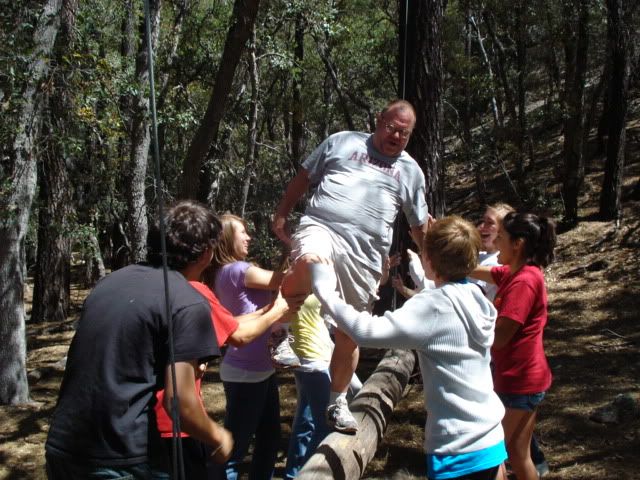
Last weekend I took a group of youth from Catalina up to Pine Canyon Camp. It was a free weekend retreat that would serve as a preview for summer camp. We took a van load and had a great road trip. There's a ton of photos here. This is my favorite photo--it's me ALMOST falling off a swinging log on the ropes course. Yes, those sweet kids were willing to put their lives on the line to catch me. What devotion! Or maybe they knew I was the only one in our group that could drive us down the mountain (you have to experience the road to Pine Canyon to know what I mean).
Sick Days
It has been a tough week. I stayed home sick Monday and then worked at home on Tuesday--I didn't want to cough all over everyone at staff meeting. After that I've been playing catch-up all week. Hopefully next week will be normal!
Thursday, April 24, 2008
What Did Jesus Say about...
This will be our the theme for our services through the month of May. On March 30 we began with "What did Jesus say about prayer?", then on April 20 we considered "What did Jesus say about the Bible?" On April 27, Seth Ginter will be preaching. The month of May looks like this:
May 4 What did Jesus say about religion?
May 11 [Pentecost and Mother's Day] What did Jesus say about the Holy Spirit?
May 18 [Trinity Sunday] What did Jesus say about himself?
May 25 What did Jesus say about politics?
May 4 What did Jesus say about religion?
May 11 [Pentecost and Mother's Day] What did Jesus say about the Holy Spirit?
May 18 [Trinity Sunday] What did Jesus say about himself?
May 25 What did Jesus say about politics?
Thursday, April 17, 2008
What did Jesus say about the Bible?
[This is the second in a series of What did Jesus say about... studies. The worship bulletin is here.]
Many (most?) Christians are uncomfortable with the Bible. They think they can't understand it. They may be offended by parts of it. They don't know their way around it. They are hesitant to be identified with some "Bible-thumpers". We may--even subconsciously--avoid the Bible.
Your view of Scripture has a profound effect on your view of theology and God and life. And all of us view Scripture with a bias. There is more than one way to look at the Bible and at theology. The views that are held by many protestants--particularly evangelicals--are only 100 years old.
But what did Jesus say about the Bible?
Many (most?) Christians are uncomfortable with the Bible. They think they can't understand it. They may be offended by parts of it. They don't know their way around it. They are hesitant to be identified with some "Bible-thumpers". We may--even subconsciously--avoid the Bible.
Your view of Scripture has a profound effect on your view of theology and God and life. And all of us view Scripture with a bias. There is more than one way to look at the Bible and at theology. The views that are held by many protestants--particularly evangelicals--are only 100 years old.
But what did Jesus say about the Bible?
Matthew 5.17-18 Jesus' aim was not to tear down the Old Testament, but to use it as a foundation to build upon.
Matthew 5.21-48 Mark 10.2-8 Jesus refused a strict literal interpretation of the Law, and sought to reveal the spirit or intent behind the Scripture.
Matthew 4.1-11 Jesus took seriously the demands of Scripture on his life and way of living
CONCLUSIONS
The Scriptures cannot be dismissed as something "for another time".
We must read the Scriptures prayerfully and seek to see and understand the heart and mind of God behind the words.
The best place to find guiding principles for my life is in the Scriptures.
Psalm 119.11, 103-105
An enjoyable morning
I rode my bike this morning to the monthly South District (of the Desert Southwest Annual Conference of the United Methodist Church) youth directors' meeting. We meet at Beyond Bread on Campbell. So that's about an 11 mile ride for me. I have new steel-belted tires that Mindy installed for me yesterday (thanks!).
So the ride was enjoyable, and I took a different route than I usually do. Normally I go Broadway to Tucson Blvd to Glenn to Campbell. Today I took Broadway to Wilmot to Pima to Forgeus to Edison to Tucson Blvd to Campbell. Can you visualize that?
Our youth directors meeting is my favorite morning all month. We gather over good food and good conversation. I enjoy catching up with my friends and talking about what is going on around the district.
So the ride was enjoyable, and I took a different route than I usually do. Normally I go Broadway to Tucson Blvd to Glenn to Campbell. Today I took Broadway to Wilmot to Pima to Forgeus to Edison to Tucson Blvd to Campbell. Can you visualize that?
Our youth directors meeting is my favorite morning all month. We gather over good food and good conversation. I enjoy catching up with my friends and talking about what is going on around the district.
Family Photos
I've posted a few family photos on my facebook profile. Scroll down to "photos". Yeah, I know, big surprise. I know my photobucket contains tons of photos. This is an attempt to make some photos more accessible.
Thursday, April 10, 2008
Jeremiah Is Preaching/Tijuana 08
Jeremiah Smith will be preaching in the Refuge this Sunday. I will be over in the sanctuary presenting our high school missions project for this summer: Tijuana 08. Youthworks is the missions agency that is facilitating our trip. We will work with kids in a VBS-like setting, and will build houses. Photos of our 2004 Tijuana trip are here and more info about our project is here. You can check out the worship bulletin with this week's Scriptures here.
Monday, April 07, 2008
Race for the Cure

Yesterday we had a great experience at the Race for the Cure! The weather was awesome, and we had about 30 (maybe more) people from our church involved! I really enjoyed talking with everyone before and after and during the Race and the Survivor Ceremony was really good! We carried a sign, so our church got some free advertising. In the competitive race, our runners placed like this:
55 Scott Kadous
91 Micah Rochin
149 Tyler Jones
189 Jordan Dansdill
and Collin Nelson didn't have his timing chip and I haven't found Chris Dansdill yet.
Thursday, April 03, 2008
NO CHURCH THIS SUNDAY!!
Is that headline a shocker for you?? This Sunday, the Refuge services will not meet in fellowship hall. Several of us are participating in The Race for the Cure. I wonder how people are taking this? But wouldn't this be kind of a test? Is the Sunday morning worship service such a sacred cow that you can't cancel it to do something really good to help people and reach out to the community? Don't get me wrong, I have heard NO criticism at all of this decision. Growing up in a church that emphasized "three to thrive" (Sunday morning, Sunday night and Wednesday night church), it feels funny to me to not be at church on Sunday morning. Plus, I'm always at Catalina on Sunday morning. That's my comfort zone.
Wednesday, March 19, 2008
Easter Sunday Worship!
Can you believe that Easter is already here? You can prepare for worship by reading our Scriptures for Sunday (1 Corinthians 15.1-20, 30-32, 58), by looking at our worship bulletin, and by looking over our Experiencing Easter Worksheet.
Thursday, March 13, 2008

Sunday March 16
This Sunday is the Sunday before Easter, that means it is Palm/Passion Sunday. Read the explanations below to understand the significance of this week in Christian worship. Also, there is a section about the Stations of the Cross. This Sunday's worship will be more experiential in nature. We will have posted throughout the hall the stations of the cross, using prints from "The Way of the Cross" by Ted Degrazia. The original art is on display in Tucson at the Gallery in the Sun. You can view these and reflect on the suffering of Christ. We will also have several prayer and meditation stations that are part of the resource Experiencing Christ's Passion.
The worship bulletin for this Sunday is here. It includes an interesting article about what happened during each day of holy week.
The worship bulletin for this Sunday is here. It includes an interesting article about what happened during each day of holy week.
History of Palm Sunday
As soon as the Church obtained her freedom in the fourth century, the faithful in Jerusalem re-enacted the solemn entry of Christ into their city on the Sunday before Easter, holding a procession in which they carried branches and sang the Hosanna (Matthew 21, 1-11). In the early Latin Church, people attending Mass on this Sunday would hold aloft twigs of olives, which were not, however, blessed in those days.
This Palm Sunday procession, and the blessing of palms, seems to have originated in the Frankish Kingdom. The earliest mention of these ceremonies is found in the Sacramentary of the Abbey of Bobbio in northern Italy (beginning of the eighth century). The rite was soon accepted in Rome and incorporated into the liturgy.
Everywhere in medieval times, following the Roman custom, a procession composed of the clergy and laity carrying palms moved from a chapel or shrine outside the town, where the palms were blessed, to the cathedral or main church. Our Lord was represented in the procession, either by the Blessed Sacrament or by a crucifix, adorned with flowers, carried by the celebrant of the Mass. Later, in the Middle Ages, a quaint custom arose of drawing a wooden statue of Christ sitting on a donkey (the whole image on wheels) in the center of the procession. These statues (Palm Donkey; Palmesel) are still seen in museums of many European cities.
PASSION SUNDAY
In the past, Passion Sunday was celebrated the week before Palm Sunday. So you had Christ crucified before he ever entered Jerusalem. This was rectified in the Revised Common Lectionary, and Palm and Passion Sunday came to share the same week. Hoyt Hickman in The New Handbook for the Christian Year says this. “Many persons have asked why the new calendar and lectionary now shared by historic Christian traditions have combined Passion and Palm Sunday into one and have suggested such an extensive amount of Scripture. To understand why this has been done , one must first recognize that the passion story is a highly dramatic and unified whole and is absolutely central to each of the Gospels. It demands to be heard in its wholeness, rather than in small bits and pieces. To focus on this story one Sunday and then the following Sunday to back up to the entry of Jesus into Jerusalem breaks the unity of the whole sweep of events from the triumphant entry through the passion and crucifixion to the resurrection. There is also a pastoral reality to face. Most persons in church on Passion/Palm Sunday will not be there again until Easter Day. To go abruptly from the lesser joy of the entry into Jerusalem to the joy of Easter, without being addressed by the passion and the cross of our Lord, is to impoverish our experience of the Gospel.”
THE STATIONS OF THE CROSS
For Roman Catholics throughout the world, the Stations of the Cross are synonymous with Lent, Holy Week and, especially, Good Friday. This devotion is also known as the "Way of the Cross", the "Via Crucis", and the "Via Dolorosa." It commemorates 14 key events on day of Christ's crucifixion. The majority concern His final walk through the streets of Jerusalem, carrying the Cross.
The Stations originated in medieval Europe when wars prevented Christian pilgrims from visiting the Holy Land. European artists created works depicting scenes of Christ's journey to Calvary. The faithful installed these sculptures or paintings at intervals along a procession route, inside the parish church or outdoors. Performing the devotion meant walking the entire route, stopping to pray at each "station."
Today, images of the Stations (or simple crosses representing them) are on display in almost all Catholic churches. They serve mainly as a focus for Lenten worship services. But the Stations can also be performed privately, at any time of the year, even at home. Many organizations offer free or inexpensive, illustrated pamphlets for this purpose.
http://www.ixeh.net/faith/Stations/via-info.html
Although Catholic in origin, the stations have been adopted for meditation, prayer, and practice by many Christian groups.
Thursday, March 06, 2008
RACE FOR THE CURE

The Race for the Cure is exactly one month from today. Here is how to get involved:
April 6 Reid Park
You are invited to be part of this life-changing event!
On April 18 1999, the First Annual Southern Arizona Race for the Cure took place in downtown Tucson. The event attracted 3,400 participants and raised $218,000. Today, nine years later, the Race for the Cure has been voted The Best Spectacle Event by the Tucson Weekly in 2004 & 2006, and raises over one million dollars each year.
Over the past nine years, the local Komen Southern Arizona Race has raised $5 million dollars. 75% of the net income has provided programs and services for breast health needs in Southern Arizona. The other 25% has gone to international research, with over one million dollars going to the University of Arizona.
Be part of our team! Pick up a registration form today or go to http://www.komensaz.org and click on “race for the cure” on the right side. Then click on “register” , then “register here”. Then click on “join a team” and then scroll down and find “Catalina UMC’.
Donate to our team! Go to http://www.komensaz.org and click on “race for the cure” on the right side. Then click on “donate or pledge” and then click on “sponsor participant”. Then enter a participant’s name. You can enter Richard Jones, Mindy Jones, Tyler Jones, or anyone else you know is participating. We will list more team member names are we receive them.
Volunteer! Volunteers are needed on race day and at the office or packet distribution locations (El Con Mall). Phone the office of the Susan G. Komen For The Cure Southern Arizona at 319-0155. The office is located at 4574 E. Broadway. Register online to volunteer at http://www.komensaz.org. Click on “volunteer” on the right side of the page, and you will be directed to a page with volunteer information.
Ask Questions! Our team captain is Mindy Jones. She is normally in the 9:30 Refuge service. You can email her at mindyrecycles@aol.com or phone her at 296-7103.
There will be no Refuge services on April 6! Instead of coming to church, come out with us and BE the church!
Jackson Pollock

 This Sunday, is the final installment in our Paint by the Spirit series. We may come back to it again. This week our artist is Jackson Pollock.
 There are many interpretations that can be given to Pollock’s work. It is sometimes referred to as Abstract Expressionism (as opposed to Impressionism). It is said to be an expression of what was inside the artist. Pollock himself said, “Modern art to me is nothing more than the expression of contemporary aims of the age that we're living in.”
Pollock practiced an “all-over” style of distribution of line and color that prevented climactic emphasis on any one point.
Pollock’s paintings had no center and this may be his main message—that the age in which he lived lacked a center, a focal point.
Notice Pollock’s comments in this interview:
WW: Mr. Pollock, there's been a good deal of controversy and a great many comments have been made regarding your method of painting. Is there something you'd like to tell us about that?
JP: My opinion is that new needs need new techniques. And the modern artists have found new ways and new means of making their statements. It seems to me that the modern painter cannot express this age, the airplane, the atom bomb, the radio, in the old forms of the Renaissance or of any other past culture. Each age find it’s own technique.
WW: Mr. Pollock, the classical artists had a world to express and they did so by representing the objects in that world. Why doesn't the modern artist do the same thing?
JP: The modern artist is living in a mechanical age and we have a mechanical means of representing objects in nature such as the camera and photograph. The modern artist, it seems to me, is working and expressing an inner world -- in other words -- expressing the energy, the motion, and other inner forces.
WW: Would it be possible to say that the classical artist expressed his world by representing the objects, whereas the modern artist expresses his world by representing the effects the objects have upon him?
JP: Yes, the modern artist is working with space and time, and expressing his feelings rather than illustrating.
National Gallery of Art site concerning "Lavender Mist"
Good article and several works here.
Our Scripture for Sunday is Psalm 46.
The worship bulletin for Sunday is here.
Thursday, February 21, 2008
February 24, 2008 Paint by the Spirit: Degas


The history of the life of Edgar Degas can be found here.
The worship bulletin for Sunday is here.
A video of Degas' work
Notice this painting by Degas. It is called Ballerina with Woman with
Umbrella on a Bench. It is one of many paintings of dancers that Degas made. Degas painted his dancers as much at rehearsal and class as he did in performance. Was he celebrating all of life? Was he valuing the process as much as the product? Was he demonstrating that the beauty of the performance could only come about as a result of great effort? And what do we make of the woman next to her? Is this her teacher? Is it her mother? Is it her governess sent to escort her to rehearsal? Does her somber clothing reveal what the brightly-clothed ballerina really thought of dance? That is was a drudgery? Is the painting showing us that the mundane in necessary to produce the beautiful?
In one of his songs, Bob Dylan said, “Behind every beautiful thing, there’s been some kind of pain.” As we see the ballerina rub her ankle, we see the truth of that statement.
There is meaning and purpose and value in all of life, even your suffering. I do not believe that everything happens for a reason, but I do believe that every experience has value. I believe that every experience impacts our lives and shapes who we are. Just as class a practice were an essential part of the lives of Degas’ dancers, suffering and trials will be inevitable parts of our lives. But we believe that God will REDEEM our suffering. Suffering is not good, but something good can come from it.
It seems that our life is like the life of the dancers. It made up more of the mundane and painful parts than the beautiful parts. What do we do? How can we keep our heads up when all we see coming down the road at us is more of the same? I think in Romans 8 Paul gives us 4 handles to help us keep a grip when life is hard. Paul said in Romans 8.18, “I consider that the sufferings of this present time are not worth comparing to the glory about to be revealed in us.” This verse reminds me of the second painting [Degas Ballerina]. Doesn’t that sound like the words of a dance instructor to her charges? I know rehearsal is hard. I know you’re sore. I know your feet hurt. But when the curtain opens and the lights come up, you will forget all about this. What are these 4 handles that allow us to get a grip on life? How can we come to focus on the glory and beauty of life over the suffering?
8.18-25 HOPE gets us through the hard parts of life. What is hope? Hope is the belief or maybe even the suspicion that something better is ahead of us. God’s redeeming of our souls in mercy leads us to hope that God will redeem the rest of our lives.
8.26-27 The SPIRIT INTERPRETS OUR PRAYERS to God. Life can be so hard and so mind-numbing at times that we don’t even know what to pray for, how to pray, or if we have the desire or strength to pray. The Spirit interprets are prayers to God in accordance to his purpose for us.
8.28-30 GOD’S PURPOSE WILL BE WORKED IN US through suffering. God will use the experiences of our lives to form our character into a Christ-like character.
8.31-39 No matter how bad things get, GOD ALWAYS LOVES US AND IS WITH US. I remember when I was little and I fell and hurt myself badly. I remember sitting on the front porch of my house in my father’s lap. My dad being there didn’t make it hurt less or heal faster, but it was extremely comforting to me just to be with him. So it is with God. God will ALWAYS be with us during our hard times. Is God even closer during our painful times? Psalm 34.18 tells us that God is near to the brokenhearted.
What’s hurting right now in your life? Where is the pain, the frustration? You can know that just as sure as God forgives your sins, he is going to redeem the rest of you, too. You may be confused, hurt. God knows just what you need, you don’t have to come up with some eloquent prayer. You don’t have to figure it out. Pain and suffering are not pleasant, but God can work in us through them. Are you dealing with hard stuff right now? Is your life a disappointment to you? Are you feeling hurt? God is near.
February 17, 2008 Paint by the Spirit: Cezanne

An Old Woman with a Rosary
The poet Joachim Gasquett tells us that this is a portrait of an ex-nun, who lost her faith and "escaped" from her convent. Gasquett found her wandering aimlessly and provided shelter for her. In Cézanne's portrait, she looks back upon a life that must have had significant pain and inner torment. And as she looks forward, she knows the days remaining to her are dwindling rapidly. So it is appropriate that the colors are somber.
[http://www.arttoheartweb.com/cezanne.htm]
But where is the light in this portrait? It is not in the hands that hold the rosary; the tool for prayer. The light is in the face. The face reflects the interior life of the woman. The face is the focus of light in the painting and her eyes are open and her eyebrow is raised with a hopeful expression.
How can this woman who has undoubtedly known so much turmoil, suffering, doubt, and anguish be hopeful at the end of her days? How? Why does she turn to prayer for her consolation, when she apparently lost her faith? Is it just a comforting habit? Is it the comfort of routine? If this was what Cezanne wanted to express, would there have been light and indications of hope in the painting? Probably not.
Cezanne was telling us that there is consolation in Christ; there is hope in Christ; and that anyone can come to Christ. Cezanne was a very religious man, a devout Catholic. You would think that we would turn away from this woman who was more than a “lapsed” Catholic—she had denied her faith, she had broken her vows. But in the simple act of prayer, this woman found her peace; her consolation in Christ. She was a member of no church, she had no organized religion. She had the religion of the heart; and in this she found the peace of Christ.
Look at Matthew 11.28-30: ‘Come to me, all you that are weary and are carrying heavy burdens, and I will give you rest. Take my yoke upon you, and learn from me; for I am gentle and humble in heart, and you will find rest for your souls. For my yoke is easy, and my burden is light.’
This is not the prevalent view of faith, of religion. For many people, religion or faith is burdensome. It is filled with do’s and don’ts and people are always judging you, and on top of all you have to do to get by in this life, you have a new set of demands: God’s demands. Either conventional wisdom (sometimes supported by a 1000 years of tradition is right or Jesus is right.
Who was Jesus talking to? People who were tired of carrying their burdens. What kinds of burdens do we carry?
our past
our sins
our worries
our hurts
our bitterness
our regrets
our failures
our what ifs and if onlys
our doubts
our confusion
our uncertainty
Jesus offers you rest. This is not necessarily the rest of inactivity, but it is certainly rest from struggle. We are meant to live following God’s way, the path of Jesus. This will be liberating for us. Restful. It will be like coming home.
Jesus asks that we come to him. Jesus asks that we enlist ourselves with him. Jesus asks that we learn his ways. This is how we will find rest. This is how we will find consolation.
Notice what Romans 8.12-16 says. When we live according to the Spirit, the inner witness in our souls is given voice and is strengthened.
1 John 3.14-24 tells us that practical acts of love will resonate in our souls that we belong to God.
A video of Cezanne's works is here.
The worship bulletin is here.
Subscribe to:
Posts (Atom)