Wednesday, March 19, 2008
Easter Sunday Worship!
Can you believe that Easter is already here? You can prepare for worship by reading our Scriptures for Sunday (1 Corinthians 15.1-20, 30-32, 58), by looking at our worship bulletin, and by looking over our Experiencing Easter Worksheet.


Thursday, March 13, 2008

Sunday March 16
This Sunday is the Sunday before Easter, that means it is Palm/Passion Sunday. Read the explanations below to understand the significance of this week in Christian worship. Also, there is a section about the Stations of the Cross. This Sunday's worship will be more experiential in nature. We will have posted throughout the hall the stations of the cross, using prints from "The Way of the Cross" by Ted Degrazia. The original art is on display in Tucson at the Gallery in the Sun. You can view these and reflect on the suffering of Christ. We will also have several prayer and meditation stations that are part of the resource Experiencing Christ's Passion.
The worship bulletin for this Sunday is here. It includes an interesting article about what happened during each day of holy week.
The worship bulletin for this Sunday is here. It includes an interesting article about what happened during each day of holy week.
History of Palm Sunday
As soon as the Church obtained her freedom in the fourth century, the faithful in Jerusalem re-enacted the solemn entry of Christ into their city on the Sunday before Easter, holding a procession in which they carried branches and sang the Hosanna (Matthew 21, 1-11). In the early Latin Church, people attending Mass on this Sunday would hold aloft twigs of olives, which were not, however, blessed in those days.
This Palm Sunday procession, and the blessing of palms, seems to have originated in the Frankish Kingdom. The earliest mention of these ceremonies is found in the Sacramentary of the Abbey of Bobbio in northern Italy (beginning of the eighth century). The rite was soon accepted in Rome and incorporated into the liturgy.
Everywhere in medieval times, following the Roman custom, a procession composed of the clergy and laity carrying palms moved from a chapel or shrine outside the town, where the palms were blessed, to the cathedral or main church. Our Lord was represented in the procession, either by the Blessed Sacrament or by a crucifix, adorned with flowers, carried by the celebrant of the Mass. Later, in the Middle Ages, a quaint custom arose of drawing a wooden statue of Christ sitting on a donkey (the whole image on wheels) in the center of the procession. These statues (Palm Donkey; Palmesel) are still seen in museums of many European cities.
PASSION SUNDAY
In the past, Passion Sunday was celebrated the week before Palm Sunday. So you had Christ crucified before he ever entered Jerusalem. This was rectified in the Revised Common Lectionary, and Palm and Passion Sunday came to share the same week. Hoyt Hickman in The New Handbook for the Christian Year says this. “Many persons have asked why the new calendar and lectionary now shared by historic Christian traditions have combined Passion and Palm Sunday into one and have suggested such an extensive amount of Scripture. To understand why this has been done , one must first recognize that the passion story is a highly dramatic and unified whole and is absolutely central to each of the Gospels. It demands to be heard in its wholeness, rather than in small bits and pieces. To focus on this story one Sunday and then the following Sunday to back up to the entry of Jesus into Jerusalem breaks the unity of the whole sweep of events from the triumphant entry through the passion and crucifixion to the resurrection. There is also a pastoral reality to face. Most persons in church on Passion/Palm Sunday will not be there again until Easter Day. To go abruptly from the lesser joy of the entry into Jerusalem to the joy of Easter, without being addressed by the passion and the cross of our Lord, is to impoverish our experience of the Gospel.”
THE STATIONS OF THE CROSS
For Roman Catholics throughout the world, the Stations of the Cross are synonymous with Lent, Holy Week and, especially, Good Friday. This devotion is also known as the "Way of the Cross", the "Via Crucis", and the "Via Dolorosa." It commemorates 14 key events on day of Christ's crucifixion. The majority concern His final walk through the streets of Jerusalem, carrying the Cross.
The Stations originated in medieval Europe when wars prevented Christian pilgrims from visiting the Holy Land. European artists created works depicting scenes of Christ's journey to Calvary. The faithful installed these sculptures or paintings at intervals along a procession route, inside the parish church or outdoors. Performing the devotion meant walking the entire route, stopping to pray at each "station."
Today, images of the Stations (or simple crosses representing them) are on display in almost all Catholic churches. They serve mainly as a focus for Lenten worship services. But the Stations can also be performed privately, at any time of the year, even at home. Many organizations offer free or inexpensive, illustrated pamphlets for this purpose.
http://www.ixeh.net/faith/Stations/via-info.html
Although Catholic in origin, the stations have been adopted for meditation, prayer, and practice by many Christian groups.
Thursday, March 06, 2008
RACE FOR THE CURE

The Race for the Cure is exactly one month from today. Here is how to get involved:
April 6 Reid Park
You are invited to be part of this life-changing event!
On April 18 1999, the First Annual Southern Arizona Race for the Cure took place in downtown Tucson. The event attracted 3,400 participants and raised $218,000. Today, nine years later, the Race for the Cure has been voted The Best Spectacle Event by the Tucson Weekly in 2004 & 2006, and raises over one million dollars each year.
Over the past nine years, the local Komen Southern Arizona Race has raised $5 million dollars. 75% of the net income has provided programs and services for breast health needs in Southern Arizona. The other 25% has gone to international research, with over one million dollars going to the University of Arizona.
Be part of our team! Pick up a registration form today or go to http://www.komensaz.org and click on “race for the cure” on the right side. Then click on “register” , then “register here”. Then click on “join a team” and then scroll down and find “Catalina UMC’.
Donate to our team! Go to http://www.komensaz.org and click on “race for the cure” on the right side. Then click on “donate or pledge” and then click on “sponsor participant”. Then enter a participant’s name. You can enter Richard Jones, Mindy Jones, Tyler Jones, or anyone else you know is participating. We will list more team member names are we receive them.
Volunteer! Volunteers are needed on race day and at the office or packet distribution locations (El Con Mall). Phone the office of the Susan G. Komen For The Cure Southern Arizona at 319-0155. The office is located at 4574 E. Broadway. Register online to volunteer at http://www.komensaz.org. Click on “volunteer” on the right side of the page, and you will be directed to a page with volunteer information.
Ask Questions! Our team captain is Mindy Jones. She is normally in the 9:30 Refuge service. You can email her at mindyrecycles@aol.com or phone her at 296-7103.
There will be no Refuge services on April 6! Instead of coming to church, come out with us and BE the church!
Jackson Pollock
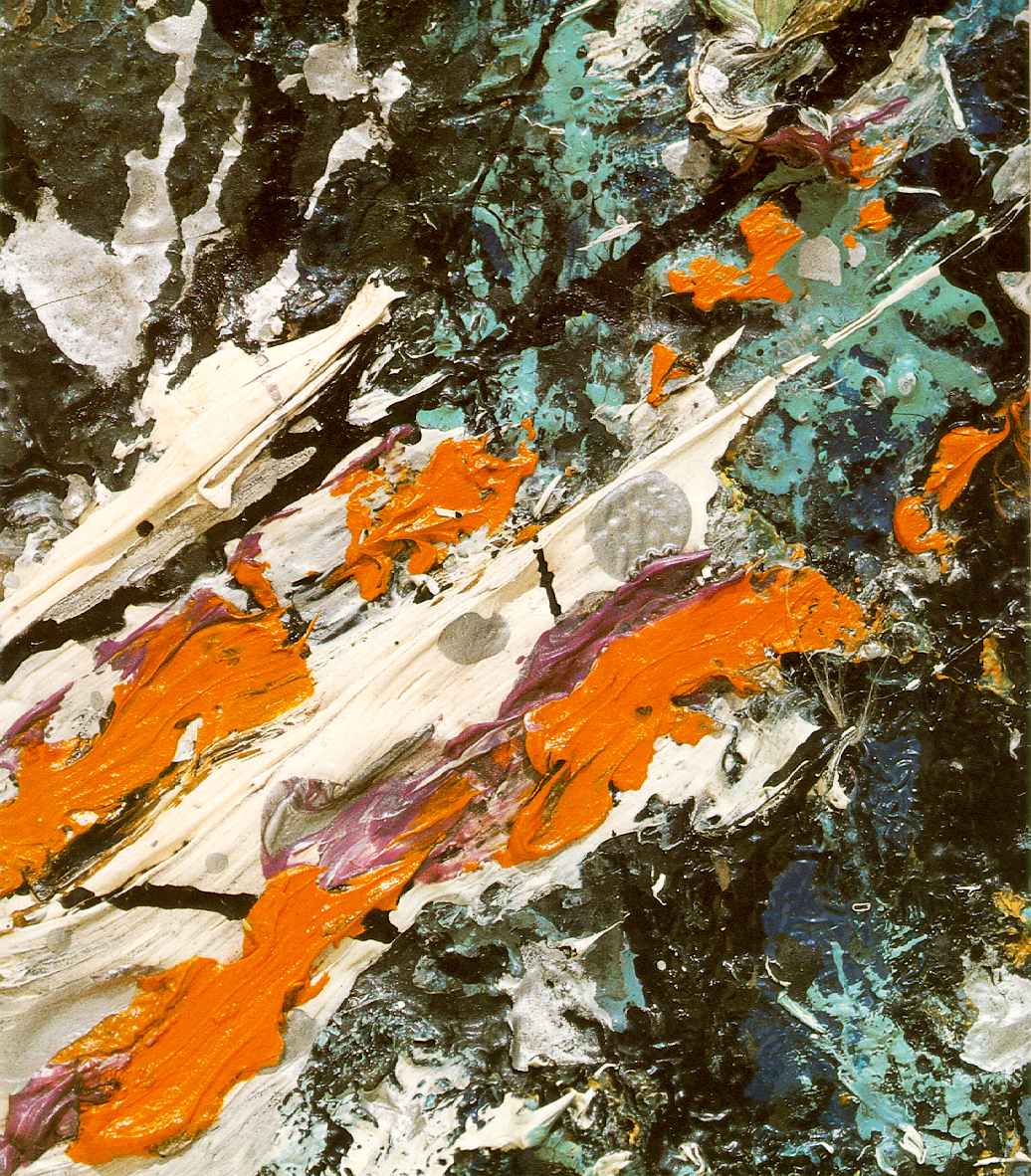
 This Sunday, is the final installment in our Paint by the Spirit series. We may come back to it again. This week our artist is Jackson Pollock.
 There are many interpretations that can be given to Pollock’s work. It is sometimes referred to as Abstract Expressionism (as opposed to Impressionism). It is said to be an expression of what was inside the artist. Pollock himself said, “Modern art to me is nothing more than the expression of contemporary aims of the age that we're living in.”
Pollock practiced an “all-over” style of distribution of line and color that prevented climactic emphasis on any one point.
Pollock’s paintings had no center and this may be his main message—that the age in which he lived lacked a center, a focal point.
Notice Pollock’s comments in this interview:
WW: Mr. Pollock, there's been a good deal of controversy and a great many comments have been made regarding your method of painting. Is there something you'd like to tell us about that?
JP: My opinion is that new needs need new techniques. And the modern artists have found new ways and new means of making their statements. It seems to me that the modern painter cannot express this age, the airplane, the atom bomb, the radio, in the old forms of the Renaissance or of any other past culture. Each age find it’s own technique.
WW: Mr. Pollock, the classical artists had a world to express and they did so by representing the objects in that world. Why doesn't the modern artist do the same thing?
JP: The modern artist is living in a mechanical age and we have a mechanical means of representing objects in nature such as the camera and photograph. The modern artist, it seems to me, is working and expressing an inner world -- in other words -- expressing the energy, the motion, and other inner forces.
WW: Would it be possible to say that the classical artist expressed his world by representing the objects, whereas the modern artist expresses his world by representing the effects the objects have upon him?
JP: Yes, the modern artist is working with space and time, and expressing his feelings rather than illustrating.
National Gallery of Art site concerning "Lavender Mist"
Good article and several works here.
Our Scripture for Sunday is Psalm 46.
The worship bulletin for Sunday is here.
Thursday, February 21, 2008
February 24, 2008 Paint by the Spirit: Degas


The history of the life of Edgar Degas can be found here.
The worship bulletin for Sunday is here.
A video of Degas' work
Notice this painting by Degas. It is called Ballerina with Woman with
Umbrella on a Bench. It is one of many paintings of dancers that Degas made. Degas painted his dancers as much at rehearsal and class as he did in performance. Was he celebrating all of life? Was he valuing the process as much as the product? Was he demonstrating that the beauty of the performance could only come about as a result of great effort? And what do we make of the woman next to her? Is this her teacher? Is it her mother? Is it her governess sent to escort her to rehearsal? Does her somber clothing reveal what the brightly-clothed ballerina really thought of dance? That is was a drudgery? Is the painting showing us that the mundane in necessary to produce the beautiful?
In one of his songs, Bob Dylan said, “Behind every beautiful thing, there’s been some kind of pain.” As we see the ballerina rub her ankle, we see the truth of that statement.
There is meaning and purpose and value in all of life, even your suffering. I do not believe that everything happens for a reason, but I do believe that every experience has value. I believe that every experience impacts our lives and shapes who we are. Just as class a practice were an essential part of the lives of Degas’ dancers, suffering and trials will be inevitable parts of our lives. But we believe that God will REDEEM our suffering. Suffering is not good, but something good can come from it.
It seems that our life is like the life of the dancers. It made up more of the mundane and painful parts than the beautiful parts. What do we do? How can we keep our heads up when all we see coming down the road at us is more of the same? I think in Romans 8 Paul gives us 4 handles to help us keep a grip when life is hard. Paul said in Romans 8.18, “I consider that the sufferings of this present time are not worth comparing to the glory about to be revealed in us.” This verse reminds me of the second painting [Degas Ballerina]. Doesn’t that sound like the words of a dance instructor to her charges? I know rehearsal is hard. I know you’re sore. I know your feet hurt. But when the curtain opens and the lights come up, you will forget all about this. What are these 4 handles that allow us to get a grip on life? How can we come to focus on the glory and beauty of life over the suffering?
8.18-25 HOPE gets us through the hard parts of life. What is hope? Hope is the belief or maybe even the suspicion that something better is ahead of us. God’s redeeming of our souls in mercy leads us to hope that God will redeem the rest of our lives.
8.26-27 The SPIRIT INTERPRETS OUR PRAYERS to God. Life can be so hard and so mind-numbing at times that we don’t even know what to pray for, how to pray, or if we have the desire or strength to pray. The Spirit interprets are prayers to God in accordance to his purpose for us.
8.28-30 GOD’S PURPOSE WILL BE WORKED IN US through suffering. God will use the experiences of our lives to form our character into a Christ-like character.
8.31-39 No matter how bad things get, GOD ALWAYS LOVES US AND IS WITH US. I remember when I was little and I fell and hurt myself badly. I remember sitting on the front porch of my house in my father’s lap. My dad being there didn’t make it hurt less or heal faster, but it was extremely comforting to me just to be with him. So it is with God. God will ALWAYS be with us during our hard times. Is God even closer during our painful times? Psalm 34.18 tells us that God is near to the brokenhearted.
What’s hurting right now in your life? Where is the pain, the frustration? You can know that just as sure as God forgives your sins, he is going to redeem the rest of you, too. You may be confused, hurt. God knows just what you need, you don’t have to come up with some eloquent prayer. You don’t have to figure it out. Pain and suffering are not pleasant, but God can work in us through them. Are you dealing with hard stuff right now? Is your life a disappointment to you? Are you feeling hurt? God is near.
February 17, 2008 Paint by the Spirit: Cezanne

An Old Woman with a Rosary
The poet Joachim Gasquett tells us that this is a portrait of an ex-nun, who lost her faith and "escaped" from her convent. Gasquett found her wandering aimlessly and provided shelter for her. In Cézanne's portrait, she looks back upon a life that must have had significant pain and inner torment. And as she looks forward, she knows the days remaining to her are dwindling rapidly. So it is appropriate that the colors are somber.
[http://www.arttoheartweb.com/cezanne.htm]
But where is the light in this portrait? It is not in the hands that hold the rosary; the tool for prayer. The light is in the face. The face reflects the interior life of the woman. The face is the focus of light in the painting and her eyes are open and her eyebrow is raised with a hopeful expression.
How can this woman who has undoubtedly known so much turmoil, suffering, doubt, and anguish be hopeful at the end of her days? How? Why does she turn to prayer for her consolation, when she apparently lost her faith? Is it just a comforting habit? Is it the comfort of routine? If this was what Cezanne wanted to express, would there have been light and indications of hope in the painting? Probably not.
Cezanne was telling us that there is consolation in Christ; there is hope in Christ; and that anyone can come to Christ. Cezanne was a very religious man, a devout Catholic. You would think that we would turn away from this woman who was more than a “lapsed” Catholic—she had denied her faith, she had broken her vows. But in the simple act of prayer, this woman found her peace; her consolation in Christ. She was a member of no church, she had no organized religion. She had the religion of the heart; and in this she found the peace of Christ.
Look at Matthew 11.28-30: ‘Come to me, all you that are weary and are carrying heavy burdens, and I will give you rest. Take my yoke upon you, and learn from me; for I am gentle and humble in heart, and you will find rest for your souls. For my yoke is easy, and my burden is light.’
This is not the prevalent view of faith, of religion. For many people, religion or faith is burdensome. It is filled with do’s and don’ts and people are always judging you, and on top of all you have to do to get by in this life, you have a new set of demands: God’s demands. Either conventional wisdom (sometimes supported by a 1000 years of tradition is right or Jesus is right.
Who was Jesus talking to? People who were tired of carrying their burdens. What kinds of burdens do we carry?
our past
our sins
our worries
our hurts
our bitterness
our regrets
our failures
our what ifs and if onlys
our doubts
our confusion
our uncertainty
Jesus offers you rest. This is not necessarily the rest of inactivity, but it is certainly rest from struggle. We are meant to live following God’s way, the path of Jesus. This will be liberating for us. Restful. It will be like coming home.
Jesus asks that we come to him. Jesus asks that we enlist ourselves with him. Jesus asks that we learn his ways. This is how we will find rest. This is how we will find consolation.
Notice what Romans 8.12-16 says. When we live according to the Spirit, the inner witness in our souls is given voice and is strengthened.
1 John 3.14-24 tells us that practical acts of love will resonate in our souls that we belong to God.
A video of Cezanne's works is here.
The worship bulletin is here.
Thursday, February 07, 2008
Paint by the Spirit the Sequel
We had such great response from our series Paint by the Spirit in the fall (and I enjoyed doing it so much) that we are bringing it back for four Sundays in Lent. We will begin on February 17 (Invite a Friend Sunday) with Cezanne. Other artists to be considered are Degas, Cassat, and Pollock. We consider their work, we look at their life story, and we consider how Scripture and the Spirit of God connects with their art. Join us for this feast of the visual senses.
What I'm Listening To


In the last week, I have been listening to these four CDs the most:
Linkin Park Minutes to Midnight
Bruce Springsteen Magic
Jimmy Eat World Chase This Light
[I received Magic for my birthday (11/29) and Minutes and Chase for Christmas.]
Top Twenty-Five Vineyard UK Praise and Worship Songs
The Perfect Church
This is my title for my message this Sunday. It is a little inaccurate. I make up titles two weeks before, when I am sending info in for the Catalina News. Sometimes my topic changes completely, and sometimes I stay on the same subject, but come up with a different conclusion or perspective. This week it is the latter. I am going to talk about the church and how we can be more of what we should be, but I'm going to take a little different approach.
We are going to watch and discuss the short video "You" from Nooma, featuring Rob Bell. We have seen a few of these videos before, always good; always thought provoking.
The worship bulletin is here.
The Scriptures for this week are:
Acts 2.44-45 All who believed were together and had all things in common; they would sell their possessions and goods and distribute the proceeds to all, as any had need.
Romans 12.4-5 For as in one body we have many members, and not all the members have the same function, so we, who are many, are one body in Christ, and individually we are members one of another.
1 Corinthians 10.16-17 The cup of blessing that we bless, is it not a sharing in the blood of Christ? The bread that we break, is it not a sharing in the body of Christ? Because there is one bread, we who are many are one body, for we all partake of the one bread.
Colossians 1.18 He is the head of the body, the church; he is the beginning, the firstborn from the dead, so that he might come to have first place in everything.
Ephesians 4.15-16 But speaking the truth in love, we must grow up in every way into him who is the head, into Christ, from whom the whole body, joined and knit together by every ligament with which it is equipped, as each part is working properly, promotes the body’s growth in building itself up in love.
Ephesians 5.29-30 For no one ever hates his own body, but he nourishes and tenderly cares for it, just as Christ does for the church, because we are members of his body.
1 Corinthians 12.12-27
Romans 8.20-25
We are going to watch and discuss the short video "You" from Nooma, featuring Rob Bell. We have seen a few of these videos before, always good; always thought provoking.
The worship bulletin is here.
The Scriptures for this week are:
Acts 2.44-45 All who believed were together and had all things in common; they would sell their possessions and goods and distribute the proceeds to all, as any had need.
Romans 12.4-5 For as in one body we have many members, and not all the members have the same function, so we, who are many, are one body in Christ, and individually we are members one of another.
1 Corinthians 10.16-17 The cup of blessing that we bless, is it not a sharing in the blood of Christ? The bread that we break, is it not a sharing in the body of Christ? Because there is one bread, we who are many are one body, for we all partake of the one bread.
Colossians 1.18 He is the head of the body, the church; he is the beginning, the firstborn from the dead, so that he might come to have first place in everything.
Ephesians 4.15-16 But speaking the truth in love, we must grow up in every way into him who is the head, into Christ, from whom the whole body, joined and knit together by every ligament with which it is equipped, as each part is working properly, promotes the body’s growth in building itself up in love.
Ephesians 5.29-30 For no one ever hates his own body, but he nourishes and tenderly cares for it, just as Christ does for the church, because we are members of his body.
1 Corinthians 12.12-27
Romans 8.20-25
Are we part of the problem, or part of the solution? This is the question that the church of Jesus Christ must ask. This is the question that Catalina United Methodist Church must ask. This is the question that you and I must ask of ourselves.
Invite a Friend
Sunday February 17 is Invite a Friend Sunday at Catalina UMC and at The Refuge. Invite someone to come with you. We all promise to behave and not to stare at the new people!
Yeah, I know.
I know I said I would catch up and be more regular with my blog, and I know I didn't. But I'm trying.
Thursday, January 17, 2008
Sunday, January 20: The Amazing Seth Ginter!!
Seth is preaching this Sunday while I will be away on Snowblast 08. Photos from last year's event are here (password is Catalina).
Anyway, Seth has gave me his Scriptures and good article to supplement the message, and I put them in the worship bulletin.
I promise to blog more next week!
Anyway, Seth has gave me his Scriptures and good article to supplement the message, and I put them in the worship bulletin.
I promise to blog more next week!
Thursday, January 10, 2008
Paint by the Spirit Returns in February
One of the studies that received the most favorable responses that I've done is Paint by the Spirit. In this study, we considered four well-known artists (Van Gogh, Picasso, Monet, Rembrandt) and the spiritual significance of their works. We will do a second series of four artists beginning February 17.
This Sunday is also our Bring a Friend Sunday at Catalina. You can use our topic as a conversation starter to invite friends to view great art and hear how the Scriptures relate.
I have not chosen artists yet, but am considering Degas, Michelangelo, Cezanne, Reubens, Renoir, Jackson Pollock, and Cassatt.
This Sunday is also our Bring a Friend Sunday at Catalina. You can use our topic as a conversation starter to invite friends to view great art and hear how the Scriptures relate.
I have not chosen artists yet, but am considering Degas, Michelangelo, Cezanne, Reubens, Renoir, Jackson Pollock, and Cassatt.
I was mad; I was sad; I was frustrated.
If you can stand it, view a slideshow of game photos here.
Yes, the Arizona Wildcats lost last night to ASU. ASU. I can't believe it and I hope you can't either. Yes, Jerryd Bayless was still out of the lineup. Yes, Brett Brielmeier re-injured his shoulder. But ASU? If you can't get up for this game, what do you expect post-season? I wonder why Kirk Walters didn't play. Does Coach O have something against him? I don't know. I'll never give up on the Wildcats, but last night's game was a severe disappointment.
At least the Suns won.
Yes, the Arizona Wildcats lost last night to ASU. ASU. I can't believe it and I hope you can't either. Yes, Jerryd Bayless was still out of the lineup. Yes, Brett Brielmeier re-injured his shoulder. But ASU? If you can't get up for this game, what do you expect post-season? I wonder why Kirk Walters didn't play. Does Coach O have something against him? I don't know. I'll never give up on the Wildcats, but last night's game was a severe disappointment.
At least the Suns won.
The Baptism of Christ
This is the second Sunday in the season of Epiphany, and the theme in the lectionary for January 13 is the Baptism of Christ. The theme of Epiphany is presenting Jesus as the Christ, so it is understandable that his baptism would be part of this consideration. At the baptism of Jesus, the Holy Spirit descended on him like a dove and the voice of God was heard proclaiming "This is my beloved Son, in whom I am well pleased." Our worship bulletin for this Sunday is here.
But why was Jesus baptized? People came to John to be baptized "confessing their sins" (Matthew 3) and for "forgiveness of sins" (Mark 1). If Jesus had no sin, why was he baptized? There are several theories as to why Jesus was baptized.
Some scholars believed that it was at the baptism that Jesus became the Christ. If this is so, there would have been no need for the miraculous birth. If this were so, John would not have recognized Jesus for who he was BEFORE the baptism.
Some hold that John's baptism was part of the initiation rite for the ascetic group living in the area known as the Essenes. It is true that John was an ascetic, hermit-type character. But Jesus never was. In fact, the Pharisees and John's disciples questioned him about his lack of asceticism (Matthew 9.9-17).
Another view is that Jesus was baptized to connect his life and ministry with that of John the Baptist. This works to a certain extent. Notice in Matthew 3.2 the message of John: “Repent, for the kingdom of heaven has come near.” Then notice in Matthew 4.17 the message of Jesus: “Repent, for the kingdom of heaven has come near.” There is a significance to the connection between Jesus and John. The Scriptures are clear that John was the forerunner for Jesus; one who goes before and prepares the way. In our language, John was the advance man for Jesus.
I am most convinced by the idea that Jesus was baptized to identify with us. Jesus was baptized not because of HIS sins, but because of OURS. When John objected to baptizing him, Jesus said, “Let it be so now; for it is proper for us in this way to fulfill all righteousness.” Jesus came to John to be baptized because he was identifying with us fully; with our human condition and need completely. As Jesus identified with us at his baptism, so we are identified with him. We are also now God’s beloved child in whom God is well-pleased (2 Corinthians 5.21, John 1.12). So, it can be said that the baptism of Christ is an extension of the incarnation. Jesus continued to show that he was truly “Emmanuel, God with us.” And as Jesus’ baptism identified him with us and our condition, so our baptism identifies us with Jesus and his condition (Romans 6.3,4).
I will elaborate on this Sunday!
But why was Jesus baptized? People came to John to be baptized "confessing their sins" (Matthew 3) and for "forgiveness of sins" (Mark 1). If Jesus had no sin, why was he baptized? There are several theories as to why Jesus was baptized.
Some scholars believed that it was at the baptism that Jesus became the Christ. If this is so, there would have been no need for the miraculous birth. If this were so, John would not have recognized Jesus for who he was BEFORE the baptism.
Some hold that John's baptism was part of the initiation rite for the ascetic group living in the area known as the Essenes. It is true that John was an ascetic, hermit-type character. But Jesus never was. In fact, the Pharisees and John's disciples questioned him about his lack of asceticism (Matthew 9.9-17).
Another view is that Jesus was baptized to connect his life and ministry with that of John the Baptist. This works to a certain extent. Notice in Matthew 3.2 the message of John: “Repent, for the kingdom of heaven has come near.” Then notice in Matthew 4.17 the message of Jesus: “Repent, for the kingdom of heaven has come near.” There is a significance to the connection between Jesus and John. The Scriptures are clear that John was the forerunner for Jesus; one who goes before and prepares the way. In our language, John was the advance man for Jesus.
I am most convinced by the idea that Jesus was baptized to identify with us. Jesus was baptized not because of HIS sins, but because of OURS. When John objected to baptizing him, Jesus said, “Let it be so now; for it is proper for us in this way to fulfill all righteousness.” Jesus came to John to be baptized because he was identifying with us fully; with our human condition and need completely. As Jesus identified with us at his baptism, so we are identified with him. We are also now God’s beloved child in whom God is well-pleased (2 Corinthians 5.21, John 1.12). So, it can be said that the baptism of Christ is an extension of the incarnation. Jesus continued to show that he was truly “Emmanuel, God with us.” And as Jesus’ baptism identified him with us and our condition, so our baptism identifies us with Jesus and his condition (Romans 6.3,4).
I will elaborate on this Sunday!
Thursday, January 03, 2008
Epiphany This Sunday, January 6
The worship bulletin for this Sunday is here. There are a lot of cool traditions centered around Epiphany. You can read about them here. There is more info here; especially read about the traditions associated with Epiphany. I think the ideas of "chalking the door" and the Epiphany cake are especially cool.
Thursday, December 13, 2007
Sunday December 23
The final theme for Advent is LOVE. Here are the Scriptures:
John1.1-18
Philppians 2.5-11
And here is the worship bulletin.
John1.1-18
Philppians 2.5-11
And here is the worship bulletin.
Third Sunday in Advent
The worship bulletin for this Sunday is here. The theme for this week is JOY. That's good, right? We all would like to, maybe NEED to, feel more joy. It's what makes the holidays special, isn't it. It seems to me from the Scriptures that joy is related to redemption. We can have joy because of redemption. See, that is why happiness is different from joy. As it has been said before, happiness is usually associated with happenings (my circumstances in life). Joy comes from knowing that I have been redeemed by God, that the biggest questions in life are settled, and that even though I may have hard times, God will work through them (redeem them) in my life (Romans 8.28).
Scriptures for this Sunday:
Isaiah 35.1-2, 8-10
Luke 2.1-20
Scriptures for this Sunday:
Isaiah 35.1-2, 8-10
Luke 2.1-20
How Big Is Your Footprint?
My wife Mindy (what? as opposed to my other wife?) sent me a link to this quiz. It measures your ecological footprint. I scored 15, when the average for my age/area was 24. Lower is better, so I guess that's good. But I would like to drive less, conserve energy more, use less water, eat more local food, and eat less red meat.
Subscribe to:
Posts (Atom)